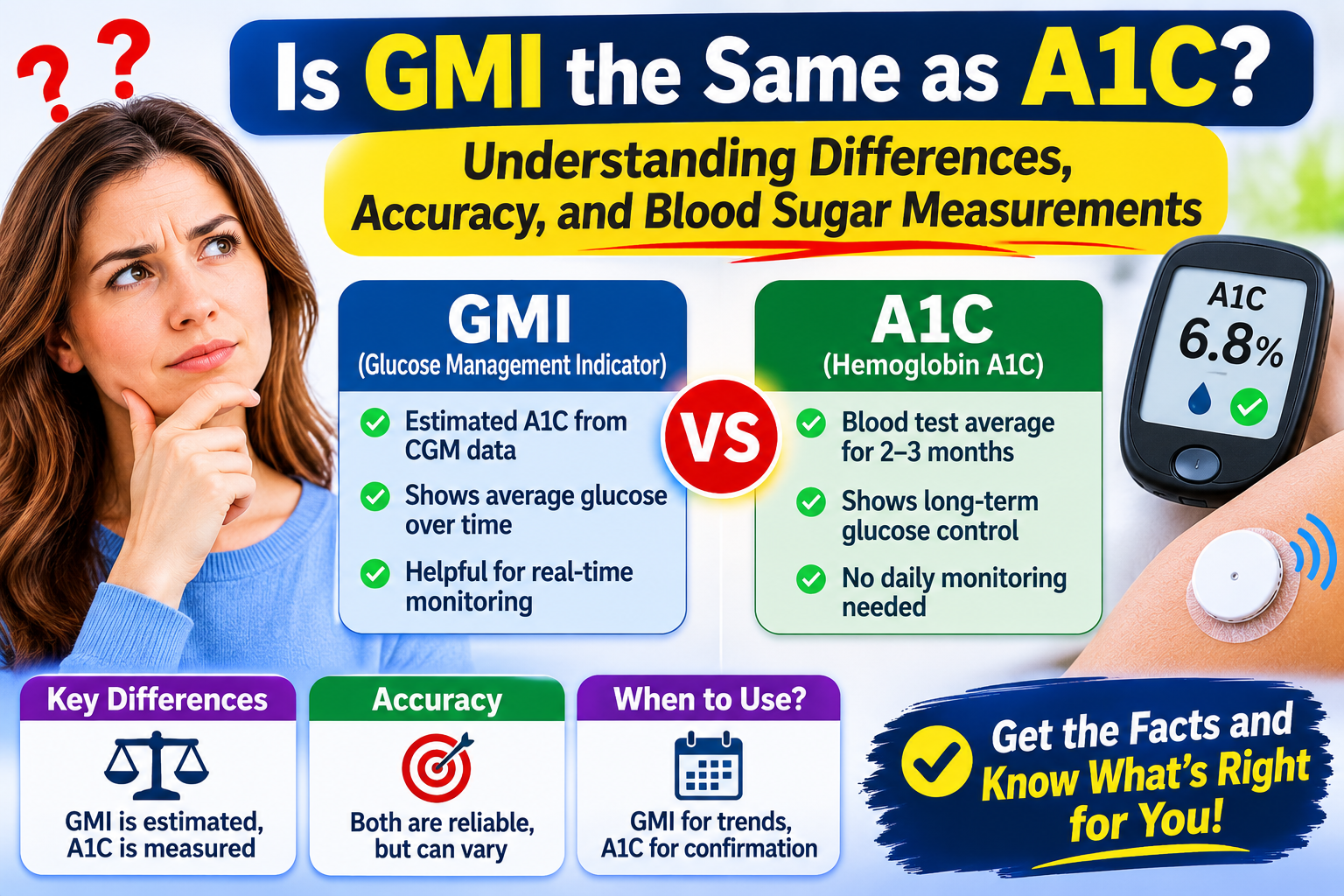
If you use a continuous glucose monitor (CGM), you may have noticed that there is a measurement called glucose management indicator (GMI) in your diabetes reports. GMI is often compared to A1C because both provide information about average blood glucose. But is GMI the same as A1C? In short, no.
Although these measurements are related, they are calculated differently and may provide different results.
Understanding the difference between GMI and A1C can help you understand your glucose measurements, monitor diabetes management, and have more informed conversations with your healthcare provider. In this guide, we’ll explain the meaning of GMI and A1C, how they are calculated, and why they may not always match.
What is GMI (glucose management indicator)?
GMI (glucose management indicator) is an estimate of your A1C based on average glucose measurements from a continuous glucose monitor.
A CGM measures glucose levels throughout the day and night. This is typically done with a small sensor placed under the skin. Unlike a single blood test, it provides ongoing information about glucose patterns.
GMI uses your average glucose data from the CGM to estimate what your A1C might be if your average glucose remained consistent.
GMI can be especially helpful for people who want to understand recent glucose patterns without waiting for a laboratory A1C test.
How is GMI calculated?
GMI is calculated using a mathematical formula based on average glucose levels.
The formula often used is:
GMI (%) = 3.31 + (0.02392 × Mean Glucose in mg/dL)
For example, if your average glucose is 150 mg/dL:
GMI = 3.31 + (0.02392 × 150)
Estimated GMI = approx. 6.9%
This estimate is not an actual laboratory A1C measurement.
What is A1C?
A1C (also known as hemoglobin A1C or HbA1c) is a blood test that measures the percentage of hemoglobin proteins in red blood cells that have glucose attached to them.
Since red blood cells typically live for about 120 days, A1C provides an average of blood glucose over roughly the last 2 to 3 months.
However, more recent glucose levels may have a stronger influence.
A1C is commonly used by healthcare professionals to diagnose prediabetes and diabetes, as well as to monitor long-term glucose management.
How is A1C measured?
Unlike GMI, A1C is measured with a blood test that is performed at a laboratory or other appropriate healthcare facility.
The results are given as a percentage.
Common ranges of A1C for nonpregnant adults:
- Below 5.7%: Normal range
- 5.7%-6.4%: Prediabetes range
- 6.5% or higher: Diabetes range (usually needs to be confirmed based on clinical guidelines)
For many adults with diabetes, an appropriate A1C target may be below 7%.
However, goals can vary depending on health conditions, age, medications, and other factors.
Is GMI the same as A1C?
No, GMI and A1C are not the same measurements.
Although they both provide information about average blood glucose, they are calculated differently and cover slightly different periods of time.
GMI is calculated based on glucose measurements from a CGM. A1C measures the amount of glucose attached to hemoglobin in red blood cells.
The key differences include:
| Feature | GMI | A1C |
| Full name | Glucose Management Indicator | Hemoglobin A1C |
| Measurement | Estimated average glucose | Glycated hemoglobin |
| Data source | CGM readings | Blood sample |
| Time period | Recent CGM monitoring period | Approximately 2–3 months |
| Result | Estimated percentage | Laboratory percentage |
| Main purpose | Monitor recent glucose patterns | Assess longer-term glucose management |
The most important difference is that GMI estimates a value similar to A1C. On the other hand, A1C directly measures glycated hemoglobin.
Why can GMI and A1C be different?
It is common for GMI and laboratory A1C results to be different. This doesn’t necessarily mean that your CGM or laboratory test is incorrect.
There are several factors that can explain the difference.
1. Different measurement periods
GMI is based on glucose measurements during your CGM monitoring period. A1C reflects glucose exposure over roughly the last 2 to 3 months.
If your blood sugar has recently improved or worsened, GMI may change before your A1C reflects the same trend.
2. Differences in red blood cells
A1C is affected by the lifespan and characteristics of red blood cells.
Conditions that affect the production or survival of red blood cells can impact A1C results, regardless of average glucose levels.
For example, anemia, recent blood loss, blood transfusions, and certain hemoglobin disorders can affect the accuracy of A1C.
3. Incomplete CGM data
GMI is more useful when you have enough CGM readings.
If your sensor is frequently disconnecting, stopping recording, or providing incomplete information, the calculated GMI may not accurately reflect your typical glucose patterns.
4. Individual biological differences
Some people naturally have higher or lower A1C results than expected based on average glucose readings.
This difference is sometimes referred to as the glycation gap or glucose-A1C discordance.
Which is more accurate: GMI or A1C?
There is no single measurement that is always more accurate. This is because they measure different aspects of glucose management.
A1C is an established laboratory test that is used to diagnose diabetes and monitor long-term glucose management. GMI provides helpful information about recent glucose exposure and daily glucose patterns.
For example, GMI can help you determine if recent changes in lifestyle, medications, or treatment plans are improving glucose levels.
A1C is helpful for understanding long-term glucose management.
However, it may be less reliable in certain medical conditions that affect red blood cells.
Healthcare professionals may use both measurements along with other information from the CGM, such as time in range, time below range, and glucose variability.
Can GMI be lower than A1C?
Yes, GMI can be lower than A1C if recent average glucose levels are better than what you experienced over the last 2 to 3 months.
For example, if you’ve recently improved your diet, physical activity, or diabetes treatment, you may have a lower GMI before your A1C decreases.
However, biological differences and medical conditions can also contribute to this mismatch.
Can GMI be higher than A1C?
Yes, GMI can be higher than A1C if recent glucose measurements are higher than the average glucose levels you experienced over the last few months.
This may happen if you’ve made changes in medication, experienced illness, stress, changes in eating habits, or physical activity.
Higher GMI doesn’t necessarily mean that your laboratory A1C is incorrect. Both measurements provide different information that should be interpreted together.
How can you use GMI and A1C together?
Using both GMI and A1C can help you get a more complete picture of your glucose management.
Here are some practical steps you can take:
- Review CGM reports: Look at average glucose, GMI, time in range, and glucose variability.
- Get regular A1C testing: Follow the recommendations of your healthcare provider for laboratory testing.
- Compare trends: See if your GMI and A1C are moving in the same direction.
- Discuss major differences: Talk to your healthcare provider about potential reasons for the mismatch, such as medical conditions or other factors.
- Don’t rely on a single number: Consider your overall glucose patterns and individual treatment goals.
If you have a significant difference between your GMI and A1C, your healthcare provider may suggest reviewing the quality of your CGM data, laboratory results, and conditions that affect hemoglobin.
Frequently asked questions (FAQs)
1. Is GMI more accurate than A1C?
Not necessarily. GMI provides an estimate based on recent CGM measurements. A1C measures glycated hemoglobin. Both have advantages and limitations.
2. Does GMI predict your A1C?
GMI estimates an A1C-like percentage based on average glucose from CGM.
However, it can’t guarantee your actual laboratory A1C result.
3. How many days of CGM data are needed for GMI?
It is often recommended to have about 14 days of CGM data with at least 70% sensor activity to interpret CGM metrics.
However, more monitoring time can provide additional information.
4. Why is my GMI 6.5 but my A1C is 7.2?
Your recent glucose levels may be lower than your average levels over the last 2 to 3 months. There may also be differences in red blood cells or other biological factors.
5. Can GMI diagnose diabetes?
No, GMI is an estimate based on CGM. It’s not a substitute for laboratory testing used to diagnose diabetes.
Final thoughts
So, is GMI the same as A1C? No, although both help you evaluate blood glucose management, they are calculated differently and provide different insights.
GMI is an estimate of your A1C based on recent continuous glucose monitor readings. A1C measures glycated hemoglobin through a blood test. There may be differences in the results due to monitoring periods, biological factors, and medical conditions.
The best approach is to use both measurements as complementary tools. Review your CGM reports regularly, follow your recommended schedule for A1C testing, and discuss any unexpected differences with your healthcare provider. Understanding both numbers can help you make more informed decisions about your diabetes management.